Eyepiece and camera cards
Short cards on how the eyepiece and the camera work, one idea each, with a worked example and the source it came from. Sky conditions decide how close you get to these numbers.
Viewing the Sun or a solar eclipse: follow NASA's eclipse safety guidance.
- Magnification is the telescope's focal length divided by the eyepiece's focal length. A 1,000 mm telescope with a 10 mm eyepiece gives 100x; swap to a 25 mm eyepiece and it drops to 40x. University of Sheffield, PHY217 telescope optics problems,
- The 500 rule: divide 500 by your lens focal length times the crop factor to get the longest untracked exposure in seconds before stars start to trail. A 20 mm lens on a full-frame camera gives 25 seconds; on a 1.5 crop sensor, about 17. New Mexico Tech, Magdalena Ridge Observatory, "Stack It",
- Exit pupil is the width of the beam of light leaving the eyepiece: aperture divided by magnification. A 100 mm telescope at 50x gives a 2 mm exit pupil. Sky & Telescope, "Choosing Your Telescope's Magnification",
- True field, the patch of sky you see, is roughly the eyepiece's apparent field divided by the magnification. A 50-degree eyepiece at 50x shows about 1 degree, around two full Moons side by side, since the Moon is about half a degree across. Chandra X-ray Center,
- A common ceiling for useful magnification is about 50x per inch of aperture, roughly twice the aperture in millimetres, and only under excellent conditions with good optics. On that rule a 100 mm telescope tops out near 200x. University of Portland, EGR491 "Telescope Specifications",
- There is a lowest useful power too. Once the exit pupil is wider than your dark-adapted pupil, some of the light misses your eye. That pupil is typically 4 to 8 mm, and it varies from person to person. University of Portland, EGR491 "Telescope Specifications",
- The Dawes limit estimates the closest pair of equal stars a telescope can split in ideal seeing: 116 divided by the aperture in millimetres, in arcseconds. A 100 mm telescope splits pairs about 1.2 arcseconds apart. OASI, "Dawes limit",
- A rough guide to the faintest star a telescope shows is 2 + 5 × log10(aperture in mm). A 100 mm scope reaches about magnitude 12. It leaves out light loss, seeing and sky glow, so treat it as a ceiling. Optics Trade, "Limiting magnitude calculations",
- The 500 rule is a starting point. Sensors with small pixels show trailing sooner, so some photographers use a stricter rule of 300, and stars near the celestial equator drift fastest. Sky & Telescope, "Astrophotography: The Rule of 500",
- A fixed tripod suits short exposures. Long-exposure sky photos need a tracking mount that turns with the sky. New Mexico Tech, Magdalena Ridge Observatory, "Stack It",
A quick sky quiz
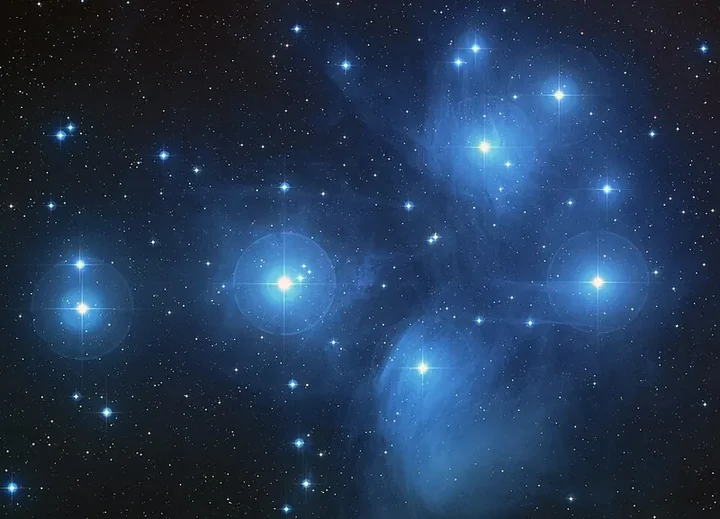
- Which object is this? A star cluster in Taurus, also called the Seven Sisters, easy to see without optics.
- The Pleiades (M45)
- The Orion Nebula (M42)
- The Andromeda Galaxy (M31)
Answer
The Pleiades (M45). NASA lists the Pleiades at about 445 light-years and magnitude 1.6, bright enough for unaided eyes. NASA Science, Hubble Messier Catalog: Messier 45
- About how far away is the Orion Nebula?
- 150 light-years
- 1,500 light-years
- 15,000 light-years
Answer
1,500 light-years. NASA gives about 1,500 light-years. At magnitude 4.0 it shows to the unaided eye from a dark site. NASA Science, Hubble Messier Catalog: Messier 42
- True or false: from a dark site you can see the Andromeda Galaxy without binoculars.
- True
- False
Answer
True. NASA lists it at magnitude 3.1 and about 2.5 million light-years away: the nearest major galaxy to ours. NASA Science, Hubble Messier Catalog: Messier 31
- Which object leaves the debris behind the Leonid meteors?
- Comet 55P/Tempel-Tuttle
- Asteroid 3200 Phaethon
- Comet 1P/Halley
Answer
Comet 55P/Tempel-Tuttle. The Leonids come from Comet 55P/Tempel-Tuttle, and their radiant is in Leo. NASA Science, Leonids
- True or false: the Geminids come from an asteroid rather than a typical comet.
- True
- False
Answer
True. NASA names 3200 Phaethon, an asteroid sometimes called a rock comet, as the Geminids' parent. NASA Science, Geminids
- True or false: Polaris, the North Star, is the brightest star in the night sky.
- True
- False
Answer
False. Polaris is easy to find because it sits near the north celestial pole, but it isn't even in the top 40 brightest stars. EarthSky, "Polaris is the North Star"
- Which star is the brightest in the night sky?
- Sirius
- Polaris
- Betelgeuse
Answer
Sirius. Sirius, the Dog Star in Canis Major, shines at magnitude -1.44, brighter than any other star. EarthSky, "Sirius, the brightest star"
- True or false: the full Moon is about half a degree across in the sky.
- True
- False
Answer
True. The Sun and the Moon both span about half a degree, which is why the Moon can cover the Sun in an eclipse. Chandra X-ray Center (NASA/Smithsonian), "Scales and Angular Measurement"